

DiverCITY
A musical exploration of the history and psychogeographies of a changing Glasgow.
by Hannah Nicole Graham, April 2026
Jamacia Street, Glasgow, 1901

What makes Glasgow?
About DiverCity

Buchanan Street, Glasgow
Introduction
DiverCity is a musical research project based on the city of Glasgow, Scotland.
The research uses qualitative and quantitative research methods from several sources; such as books, articles, YouTube videos and city observations. All of which you can find referenced throughout this site.
Findings are displayed in the form of four songs, contextual paragraphs and photographs to support the findings. There are so many attributes which combine to make this great, diverse city unique, this research concentrates on several main concepts.
The main themes of the songs are the social and cultural contributions to Glasgow (music and migration), transformation (post-industry) and psychogeography.
The four track names are 'City’s Heart', 'Promise', 'Dear Green Place' and 'Going Out Out'.
Field Recordings
This body of work features genuine field recordings taken in the ‘City Centre’ and ‘West End’ of Glasgow. These recordings enhance the content of the songs by making them authentic to the city and immersive for the listener.
You can experience the full immersive, listening journey below, as well as delve into each song individually.
DiverCITY- A journey through Glasgow
Continue scrolling to discover the inspiration behind each song...
Track 1- City's Heart
“Glasgow is Scotland’s largest and most diverse city”
(Glasgow City Council, 2019)
In the first song, we are introduced to the city of Glasgow. The song is written from the perspective of Glasgow as a person. There is so much to incorporate into writing about Glasgow, so this introduction song includes an overview of the city's past and present.
The first verse talks about Glasgow’s appearance, including potholes, litter and buildings made of sandstone that feature greatly in the city. The iconic sandstone tenement buildings were first built during the industrial revolution in the Victorian era, where the boom of industry workers needed housed (Campbell, 2017). Many tenements were clearly built to last as they are still standing and notoriously Glaswegian. Ones that were poorly built were knocked down during Glasgow’s regeneration.

Tenement buildings in Glasgow
Glasgow’s reputation hasn’t been perfect. In the 17th century, many Glaswegian's were heavily involved in the transatlantic slave trade (Hamilton, 2013). Slave owners and tobacco lords made profits from their tobacco plantations when merchandising in Glasgow.
Even James Watt, an engineer from the University of Glasgow, was “personally involved” in the selling of a black child to a Scottish family (France-Presse, 2022).
Some people feel that Glasgow has yet to fully acknowledge and come to terms with its involvement. During the “Black Lives Matter” campaign, Glasgow authorities apologised for the city's role in the transatlantic slave trade, saying the “tentacles” of slavery were latched into the very bones of the city (France-Presse, 2022). Over 62 Glasgow street names are named after slave owners and political figures. Many Glaswegians have benefited from their family wealth which was accumulated from slave trades as well as plantation profits (Iredje, 2022).
In more recent times, Glasgow was dubbed “The murder capital of Europe” in the early 2000s. Since then, figures have improved, particularly due to the ‘Violence Reduction Unit’, tackling the city’s gang violence and knife crime (Geoghegan, 2015).

Slave examination

James Oswald, Slave owner and politician
Despite the negatives of the city, there are many positives that make Glasgow an attractive place to live.
The slogan “People Make Glasgow” was pioneered in 2013 as part of Glasgow’s marketing campaign (BBC, 2013a). This was to help to promote the city for hosting the 2014 Commonwealth Games (BBC, 2013b). This helped people view Glasgow in a favourable light, revealing a community with friendly people. There is also a real sense of camaraderie with the people of Glasgow, they like a joke and especially on nights out just want to have a laugh.
"People Make Glasgow"
-Glasgow Commonwealth Games, 2014
The song acknowledges that many inventions were made in Glasgow. Noteably the invention of the television by John Logie Baird. Glasgow was also thriving, due to the invention of the steam engine, by James Watt, and became a leading city in the industrial revolution. Both inventors were former students of Glasgow University.

Glasgow is also a city of arts and culture. The arts and culture side of Glasgow is so prevalent today, partly due to the efforts in post-industrial regeneration projects. On the Clydeside, the SEC was built to draw in international business, followed by the Armadillo and SEC Hydro. This was criticised for not engaging with local communities, focusing too much on tourism and providing low-income/ no skill jobs to locals (Kintrea and Madgin, 2019, pp. 239-250). There are many successful theatres in Glasgow, including the King’s Theatre, Theatre Royal and the newly refurbished Citizen's Theatre. They hold worldwide and local productions.
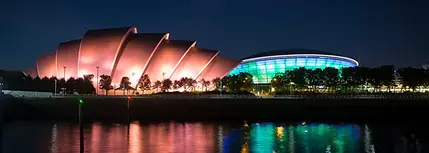
The Armadillo and the SEC Hydro
Other verses of the song acknowledge that Glasgow thrived on the surface, but the wealth gap between the rich and poor was large, much like today. There is still widespread deprivation in Glasgow, compared to wealthy areas such as Hyndland road in the west end. However, Glasgow strives to improve. Locals start community groups for youths and entities, such as the Citizen's Theatre. The Citizen's Theatre run many rehabilitation workshops, improving people's quality of life.
People looking at the shipbuilding on the Clyde.
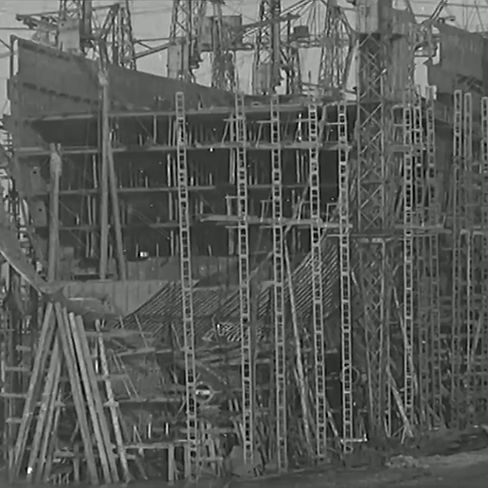
Additionally, Glasgow was one of the leading places in the Industrial Revolution. Shipbuilding business was booming and it was always a place where merchants would trade, due to the River Clyde providing easy access for the city. Many people came and went from Glasgow, either because they were merchants bringing goods from countries such as India, or due to them migrating to places including North America, New Zealand, the Caribbean and Australia (BBC, n.d.).

Citizens Theatre, Gorbals

Track 2- Promise
“Glasgow is Scotland’s most ethnically diverse city, home to a rich mosaic of communities whose cultures, traditions and experiences shape the city’s unique character” (Harkins and Ahmed, 2025).
Govan Shipyard
Glasgow is a very ethnically diverse city and nowadays many politicians focus on the negative effects of immigration. This song ‘Promise’ focuses on the migration of highlanders to Glasgow and how they powered Scotland’s growth during the industrial revolution, making it the fastest growing country compared to other European countries of similiar size (Steel, 2024).


Glasgow Slum
The Highland Clearances took place from 1750-1860 (Steel, 2024). The Highland Clearances caused a massive displacement of Highlanders, as they were forcibly removed from their generational homes, eradicating the clan system and generational wealth.
After the Jacobite rising ended at the Battle of Culloden 1745, English rule took over and there were new landlords that wanted to maximise their profits by reworking the land to include bigger farms and more sheep (Soutar, 2025). Sheep were more profitable for their meat and wool, they could also survive on poor quality soil. The tenants weren’t as profitable, as rent was usually paid in trades and kind rather than money. Landlords raised their rent and were said to set houses on fire so inhabitants couldn't return. Many new landlords were wealthier and money hungry, they accumulated the land as sympathisers of the Jacobite uprisings had to forfeit their estates (Soutar, 2025).
"Tired temples built from the day...
... I am afraid but brave"
- Promise by Hannah Nicole
Scottish Family during Highland Clearances
To strip the clans from power after the Battle of Culloden, laws banning Gaelic, traditional clothing and the right to own arms meant people were stripped of their identity.
Some highlanders were uprooted to the coast to live in unviable crofts with infertile soil. The same potato disease that ravaged Ireland affected the West Highland crofters, meaning crops were ruined and food/ money was scarce (BBC, n.d.).
Highlanders were essentially seen as a potential workforce that could help enrich the military, kelping industry and fishing... undesirable work industries to the rich. Lack of farming and being uprooted from clachan’s, meant people must find work elsewhere, resulting in many immigrating abroad or south to cities like Edinburgh and Glasgow.

Shipbuilding on the Clyde

Upon arrival in Glasgow, the city was overcrowded, loud and foul smelling. The highlanders, due to their low income, lived in one or two room tenement houses (Smillie, 2024a). Varied quality of tenements were built around the city, meaning some of them fell into disrepair and ended up as slums, such as the Gorbals. Overcrowding meant roughly 50 tenants shared a toilet which brought disease.
Shipbuilding took over Glasgow, in particular areas like Govan. Due to migration, in 1864 the popuation grew to 9000 people and by the end of the century the population was 90,000. Work was brutal, 54 hour weeks starting at 6am everyday. There were no safety measures put in place, men stood on high planks with no rails, deaths occurred frequently and many were not recorded. As the population figures increased, employment became insecure. Men would eagerly stand at shipyard gates in the morning hoping to get chosen for work, if they didn't get selected they would have to move onto the next shipyard (O’Neill, 2022).
Compared to the quiet highlands, Glasgow would have seemed like a nightmare and not the dream they were promised.
Old tenement housing
Track 3- Dear Green Place
Dear Green Place
'Dear Green Place'- Gaelic translation='Glasgow'
The benefits of green spaces are well documented, they improve the climate and air we breathe, help reduce health inequalities, improve mental health, regenerate and connect communities. They also encourage investment into the area, the closer buildings are to attractive green places, the higher the property value (Glasgow City Council, 2019, pp. 6-7).

Victoria Park, Glasgow, Victorian Era
In the mid 19th century, as Glasgow became more densely populated, the city council realised they had to address the lack of green and open spaces within the city. Kelvingrove was the city's first government funded public park (Maver, 1998, pg. 325). In 1872, Glasweigians collectivley advocated for more parks in the city (Maver, 1998, pp. 323-325).

Queens Park, Glasgow, Victorian Era
In Glasgow, we are lucky to have so many pretty green spaces (Smillie, 2024b). The word itself ‘Glasgow’ translated from Gaelic means “Dear Green Place” (Glasgow City Council, 2019, pg.4). There are many Victorian styled parks, passed down from generations and cherished by Glaswegians (Glasgow City Council, 2019, pg.4-5).

Victoria Park, Glasgow

1.
The East End of Glasgow, where most of the factories were located, had Glasgow Green. Since the air was so highly polluted in the East End, the Green didn’t do enough to improve the air quality. People complained there was underinvestment in Glasgow Green compared to Kelvingrove. Glasgow Green was nick named the ‘People’s Park’ as it was less middle/upper class than the favoured west end park Kelvingrove, where there were signs to keep off the grass etc (Maver, 1998, pg 330-331).
Eventually, more parks including Queen’s Park, Alexandra Park and Ruchill Park were built. It was said that some parks were less desirable than others, for example Alexandra in the East End was polluted as soot and fumes from the factories would blow into the park.
Kelvingrove Park, West End, Glasgow
2.
Despite this, post-industry, these parks helped the air quality recover and provided a place where people could escape from the overcrowded city.
Post-industry, the city’s environment was poor. This was mainly due to human pressures causing environmental degradation such as contaminated land and soil from factories, shipbuilding, overcrowding and the sanitation/ health issues that came with that. The city's environment has a direct correlation with the public's health (Kintrea and Madgin, 2019, pp.257-258). Thus, it is in everyone’s best interest that Glasgow’s environment is of a high standard.
3.
Expanding, maintaining and improving parks can help tackle the poor environment, as well as the city’s implication of a ‘Low Emissions Zone’ (Glasgow City Council, n.d.).
Places such as museums, bandstands and promenades help promote art and culture and attract more usage of the parks (Glasgow City Council, 2019, 89-90).
Now closed for refurbishment and due to open in 2027, the People’s Palace is a museum that is beside Glasgow Green, it has told the stories of Glaswegians for 125 years. Kelvingrove Art Gallery and Museum, situated in Kelvingrove Park, has helped elevate the park into a home for Glasgow’s institutions of science and art to help educate citizens (Maver, 1998, pp.344-345).
“Parks and greenspaces will be lively, welcoming and safe places; sustainable, well connected and accessible to all, providing opportunities for activities and shared use for current and future communities.” (Glasgow City Council, 2019, pg. 20)
4.
Free entry, parks are accessible and a hotspot of activity in the summer months, with sports, community groups, gigs and people having picnics.
Parks challenge the psychogeography of the city, they are public and you can wander wherever you want, rebelling against the social norm of familiar paths. This goes against the grain of a city where people mainly take the same streets and paths. Where areas are often “overlooked or forgotten about”, parks in cities are a free safe haven (Coverly, 2012, pp.12).
5.
For instance, to get to the train station from Sauchiehall Street, people may prefer to walk to Buchanan Street and then along, rather than cutting across the quicker side streets. In many Glasgow parks you can walk on the grass, in between trees and go beside the river, in the instance of Kelvingrove.
Psychogeography is the study of the link between geographical environment, behaviours and emotions (Coverly, 2012, pg.10). An example of this is Charles Baudelaire’s flâneur.
Charles Baudelaire is a French Poet who writes in the perspective of a character that wanders the streets of Paris, often referred to as the ‘flâneur’.
6.
The flâneur observes society, often referencing nature and people he meets along the way(Baudelaire, 2011).
Parks encourage Glaswegians to people watch, and stop to take in nature, instead of getting caught up in the hustle and bustle of city life.
It shows how important open spaces are, “the fate of the flâneur is bound with the fate of the city he inhabits and his very existence...it acts as an indication of the struggles later generations of urban walkers will have to face as the city is redeveloped in a manner increasingly hostile to their activities” (Coverley, 2010, pg.20).
In a constantly changing city, it is important that green spaces are protected for the wellbeing of generations to come.
Track 4- Going Out Out

Glasgow is notorious for its music venues and nightlife. It became the UNESCO city of music in 2008
(Molleson, 2015, pg6).
Barrowland Ballroom, Glasgow


Barrowland Ballroom, Glasgow
Since medieval times, music has shaped the city of Glasgow. St Mungo founded his cathedral in the 6th century, where Glasgow Cathedral now stands. Music was essential to the catholic church, with intricate music being a part of daily prayer. St Mungo church once housed hundreds of music books, unfortunately all were lost in a fire (Molleson, 2015, pp.18-23).
In the mid 1800s, the City Hall opened in Candleriggs; not only was it used for city meetings and debates open to the public, it also served as a theatre for orchestral music, making it accessible to locals. “We are glad to see the working classes patronising these concerts so extensively, for we believe they could not spend a Saturday evening better than by attending the city hall” (Molleson, 2015, pg.27). Despite the Royal Concert Hall now being the favoured venue since 1990, the City Halls are still home to the BBC Scottish Symphony (Molleson, 2015, pg 24).
A popular venue for singsongs is the ‘Scotia Bar’, which was the home of folk music and launched the careers of legends such as Billy Connolly, Tam Harvey and Mick Broderick. Along with regulars they would perform folk songs and tell comedic stories (Molleson, 2015, pp.42-45). The Scotia bar was well loved, including with the local police, therefore got away with singing and being loud.
Another beloved venue, once notorious for dancing is the Barrowland Ballroom. Located in ‘The Barras’ market, the venue was first opened in 1934 by Margaret McIver, an entrepreneur, who built the venue to hold her annual Christmas party. This was to say thank you to her loyal market stall tenants. Margaret realised she could make profit from the venue and started renting out to local bands (Molleson, 2015, pp. 95-103). After Margaret passed away in 1958, the venue burned down shortly afterwards in November of that year. It was rebuilt bigger and reopened in 1960, with Canadian maple wood floors and a curved ceiling, creating amazing acoustics (Molleson, 2015, pg. 91). It was very popular in the 60s and 70s for dancing. Nowadays, the venue remains very popular, being used regularly for gigs.
Immigrants from the Highland Clearances and Irish potato famine brought Celtic music and culture to Glasgow. An influx of Gaelic speakers, they brought instruments such as fiddles, pipes and clarsach's (Molleson, 2015, pp.7-12). Migrant workers also brought folk songs and new dance into the city, such as jigs and reels. Often folk music occurred out with formal venues as “immigrant communities didn’t tend to show their ethnic colours in public” (Molleson, 2015, pg. 12). However, tradition is celebrated today, with ceilidhs and folk jam sessions being held in pubs like Sloans and the Scotia bar. The city has a history of having iconic music venues, big and small. With the city’s workforce growing, the demand for entertainment increased, resulting in pubs converting backrooms into singing saloons for Cabarets.


The Scotia Bar
The Locarno Ballroom, Sauchiehall Street

There was a time when Glasgow had a higher proportion of dance halls to the population than anywhere else in the UK. The Locarno Ballroom on Sauchiehall street was an iconic dance venue, which changed it's name to Tiffany's in the 1960s and is now a casino (Yin, 2024). It held the first Scottish Professional Dancing Championships and was popular with American servicemen during the war.
What once was a row of Georgian homes on Sauchiehall street, housing the wealthy shipyard owners and merchants, now stands rows of bars and clubs. The Garage Attic, music venue, is located in the building of an old Georgian home (Yin, 2024). The Garage has hosted many popular acts such as Prince in 1995, One Direction, Coldplay, Radiohead, Marilyn Manson, Biffy Clyro, Kasabian, Pulp, Paolo Nutini as well as The Charlatans in 1977.
Unfortunately, many Glasgow music venues and buildings have been destroyed or closed down. Such as The O2 ABC, The Art School and St Andrews Halls that were destroyed by fires. COVID-19 also had a very negative effect on venues, with footfall being low and some never recovering and having to close permanently.
City Halls and the Old Fruitmarket
Another worthy venue mention is King Tuts Wah Wah hut. Opened in 1990, the venue has been an accessible place for small bands to gain global success. When opening, Tam Coyle dealt with the bands and became the first in a line of well-versed promoters, working tirelessly to uncover unknown talent (Molleson, 2015, pp.157-161).
DF concerts which started off in the small office above the venue, took over and now run hundreds of gigs a year, including hosting festivals such as TRNSMT. A few famous people who played here in their early years include Paolo Nutini, The Charlatans, The Snuts, Blur and Oasis.

Oasis at King Tuts
It is important we support the local venues, to enrich Glasgow’s music scene and to prevent empty units which are common on Sauchiehall street. It was once Scotland’s busiest and best shopping street, now half empty and filled with characterless chains and charity shops (Sanderson, 2023).
“Going Out Out” encapsulates how great it is to go out in Glasgow and the feeling of being invincible that comes with it. Comedian Micky Flannagan once did a skit about the difference between going out and ‘going out out’. ‘Going out out’,meaning that it is not a casual, quick drinking session and that you will be staying in town until early hours the next day, not wanting to call it a night (Stroud, 2018).
Collaborations
Valued Partnerships
Spending months preparing and researching for this project, it is hard for me to believe that it is finished, not having to look at it again if I choose! It has surprisingly been an enjoyable process, despite it being my 4th year dissertation for University and the extra pressures that come with that.
Reflecting on this, part of the enjoyment of this project was due to the advice and collaborations with the following people...
Dr Iain Taylor
Sandy Jones
Charlie Fraser
My supervisor, Dr. Iain Taylor has guided me throughout this process. From advice on how to narrow down my research question, as well as giving suggestions which allowed my songwriting to flourish. He has been a constant, positive figure, helping drive this project to completion. Toward the end of our weekly meetings, he observed something that stuck with me... I had poured so much of myself into this project, that it was no longer about the grades, it was about proving that I can make this project something amazing for myself and improving my skills as a songwriter forever.
Sandy Jones from The Foundry Music Lab, Motherwell, produced my songs into intricate arrangements. I thoroughly enjoyed going into the studio with a vision and seeing the stories come to life and develop into something even better than imagined. Sandy’s patience, dedication to my art and genuinely wanting the songs to sound their best shows in the final versions.
Last but not least, guitarist Charlie Fraser helped me compose the last song ‘Going Out Out'. Charlie arranged chords and guitar parts that hold their own energy. Combining a few different sections and chord ideas he previously had for separate songs, we loved the contrast and excitement of how they sounded together. Once I came up with a melody and lyrics, the song felt complete. The contrasting sections of this song reflects the diversity theme of the project, which seemed like a fitting end to the journey through Glasgow.
THANK YOU for your contributions to this project :)
REFERENCE LIST:
Baudelaire, C. (2011). THE FLOWERS OF EVIL. Project Gutenberg. London: Elkin Mathews.
BBC (2013a). ‘People Make Glasgow’ unveiled as new city brand. BBC News. London: Royal Charter
BBC (2013b). International response to Glasgow rebranding project. BBC News. London: Royal Charter
BBC (n.d.). Reasons for emigration - Scottish emigration 1830s-1939 - National 4 History Revision. BBC Bitesize. London: Royal Charter
Campbell, R. (2017). A History of Glasgow Tenements. Glasgow: Cairn Estate & Letting Agency.
France-Presse, A. (2022). Glasgow apologises for role in slave trade, saying its ‘tentacles’ are in every corner of city. York: The Guardian News and Media Limited
Geoghegan, P. (2015). Glasgow smiles: how the city halved its murders by ‘caring people into change’. York: The Guardian News and Media Limited.
Glasgow City Council (2023). Glasgow’s Low Emission Zone. Glasgow: Glasgow City Council
Glasgow City Council (2019). Our Dear Green Place: A vision for Glasgow’s parks and greenspaces – working for our communities 2019. Glasgow: Glasgow City Council.
Hamilton, D. (2013). Scotland, the Caribbean and the Atlantic world, 1750–1820. Manchester: Manchester University Press.
Harkins, C. and Ahmed, M. (2025). Glasgow City Ethnicity Profile. Glasgow: Glasgow Centre for Population Health/Health Determinants Research Collaboration Glasgow.
Iredje, R. (2022). Glasgow’s statues have connections to the Atlantic slave trade. BBC News. London: Royal Charter
Kintrea, K. and Madgin, R. (2019). Transforming Glasgow: beyond the post-industrial city. Bristol: Policy Press.
Maver, I. (1998). Glasgow’s public parks and the community, 1850–1914: a case study in Scottish civic interventionism. Urban History. Cambridge: Cambridge University Press, pp.323–347.
Molleson, K. (2015). Dear Green Sounds. Glasgow: Geddes & Grosset, Limited.
O’Neill, C. (2022). The Govan museum keeping Glasgow’s incredible shipbuilding heritage alive. Glasgow Live. London: Reach
Sanderson, G. (2023). How it went wrong for Glasgow’s biggest shopping street. The Herald. Glasgow: Newquest Scotland
Smillie, L. (2024a). How Glasgow became tenement city in 28 pictures exploring the social history of Glasgow. GlasgowWorld. Leeds: National World
Smillie, L. (2024b). Glasgow’s the greatest: 12 reasons why Glasgow is the best city in Britain. GlasgowWorld. Leeds: National World
Soutar, K. (2025). The Highland Clearances - Historic Environment Scotland Blog. Edinburgh: Historic Environment Scotland Blog.
Steel, R. (2024). Scottish History: The Highland Clearances. Aviemore: Wilderness Scotland.
Stroud, C. (2018). Experts finally reveal the difference between going out and going out-out. The Sun. London: News Group Newspapers
Yin, P. (2024). History and Modern Tour of Sauchiehall Street - Glasgow, Scotland. California: Youtube.